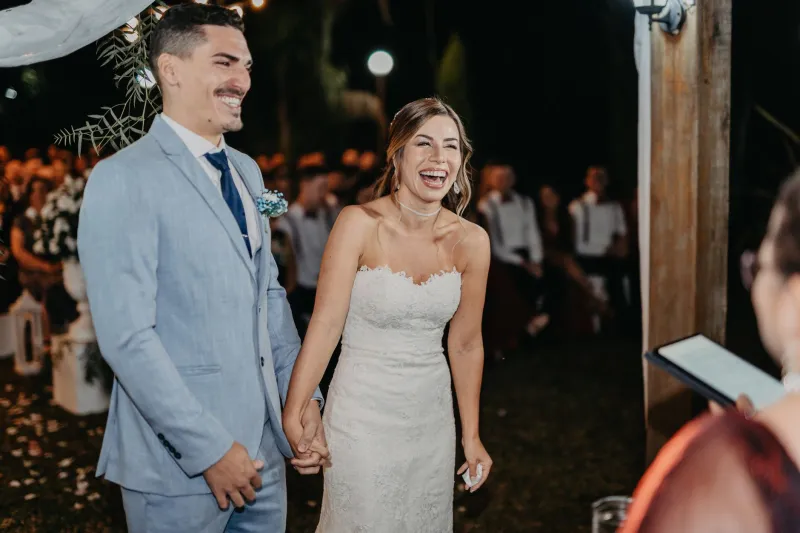
The Invisible Hand: How Masterful Wedding Coordination Works Best When No One Notices It

There is a particular kind of excellence that announces itself through absence. A door that opens precisely when needed, a florist who slips out before the first toast, a timeline that flows so naturally that guests assume the day simply unfolded that way on its own. This is the paradox that lives at the heart of professional wedding coordination: the better the work, the less anyone sees it being done.
For couples investing in a coordinator, this can initially feel counterintuitive. Why engage a professional whose defining quality is invisibility? The answer, once understood, reframes the entire value proposition of expert planning—and illuminates why the couples who work with seasoned coordinators so often describe their wedding day as effortless, even magical.
The Stage Manager Principle
Theatre offers the most precise analogy for what a wedding coordinator actually does. Every Broadway production depends on a stage manager whose name never appears on the marquee, whose face the audience never sees, and whose success is measured entirely by how seamlessly the performance proceeds. Lighting cues land on the right syllable. Actors find their marks. Curtains rise and fall with quiet authority. When the stage manager does the job well, the audience experiences only the story.
Wedding coordination operates on the same principle. The couple are the performers. The guests are the audience. And the coordinator is the professional in the wings, holding the entire production together through preparation, communication, and calm decision-making that never breaks the fourth wall.
This requires a particular kind of discipline—one that subordinates personal visibility to the integrity of the event. A coordinator who steps forward to manage a problem in full view of the guests has, in a meaningful sense, failed to manage it properly. The goal is resolution without disruption, correction without spectacle.
What Invisibility Actually Requires
There is nothing passive about disappearing well. The coordinators who move through a wedding day without drawing attention do so because of meticulous preparation that begins weeks, sometimes months, in advance.
Every vendor receives a detailed timeline with contact information, arrival windows, and contingency instructions. Every member of the venue staff understands their cues. Every potential failure point—a delayed florist, an early arrival from the officiant, a bridal party member who wanders—has been anticipated and assigned a quiet protocol. The coordinator does not improvise on the wedding day so much as execute a plan that was designed to absorb uncertainty without surfacing it.
This preparation is what allows problems to be solved before they become visible. A seating chart discrepancy resolved during cocktail hour never reaches the dinner table. A vendor running fifteen minutes behind is absorbed into a timeline buffer that guests never knew existed. The couple moves from one moment to the next without the friction of logistics, because someone has already smoothed the path.
Communication as the Invisible Architecture
If preparation is the foundation of seamless coordination, communication is its architecture. A coordinator's ability to remain invisible depends almost entirely on how thoroughly information flows between every participant before the day begins.
This means not simply sending a timeline, but confirming that every vendor has read it, understands it, and knows who to contact if something shifts. It means briefing the couple's families on what to expect and when, so that well-meaning relatives do not inadvertently create delays. It means establishing a single point of contact—the coordinator—so that questions and concerns converge in one place rather than creating competing conversations.
On the day itself, communication continues through a system of subtle signals: a quiet word to the bandleader, a gentle hand on the shoulder of a nervous father of the bride, a text to the catering manager that the ceremony ran four minutes long. None of this is visible to the couple or their guests. All of it is essential.
Letting the Couple Own the Room
Perhaps the most important dimension of invisible coordination is the intentional act of creating space for the couple to be fully present. This is not simply a matter of staying out of photographs. It is a philosophy about where attention should flow on a wedding day.
When a coordinator is operating at the highest level, the couple never feels managed. They are not handed a schedule and moved through it like a checklist. Instead, they are guided through a day that feels natural and unhurried, because someone else is carrying the weight of the clock, the vendors, and the logistics. The emotional bandwidth that might otherwise be consumed by coordination concerns is freed entirely for connection—with each other, with their families, with the moments that will define their memories of the day.
This is the most profound gift a coordinator can offer, and it is one that only becomes possible through the deliberate practice of stepping back. Every decision a coordinator makes should be filtered through a single question: does this serve the couple, or does it serve the coordinator's need to be seen solving it?
The Trust That Makes It Possible
For couples, engaging this kind of coordination requires a particular act of faith. Handing over the logistics of one of the most significant days of your life to another person—and trusting that they will handle it without constant check-ins or visible management—is not a small thing.
This is why the relationship between a couple and their coordinator is built long before the wedding day itself. Through detailed planning conversations, thorough questionnaires, and a shared understanding of the couple's values and priorities, a coordinator builds the kind of knowledge that allows them to make decisions independently and confidently. They know what matters most. They know where the couple is willing to flex and where they are not. They know the family dynamics, the vendor personalities, and the moments the couple has been anticipating for months.
With that foundation in place, the coordinator can act with authority on the day—not because they have been given unchecked control, but because they have earned the trust to exercise good judgment without interruption.
The Measure of Excellence
At the end of a well-coordinated wedding, guests often remark on how smoothly everything went. They speak of the day as though it simply happened—as though the timing were a matter of fortune, the transitions a product of good luck. Couples who have worked with a skilled coordinator know better. They know that the ease they felt, the presence they were able to bring to each moment, the absence of stress in what might otherwise have been an overwhelming day—all of it was crafted, carefully and invisibly, by someone whose highest professional aspiration was to go unnoticed.
That is not a small thing. It is, in fact, the art.