Between the Lines: How the Quietest Moments of Your Wedding Day Become the Ones You'll Never Forget
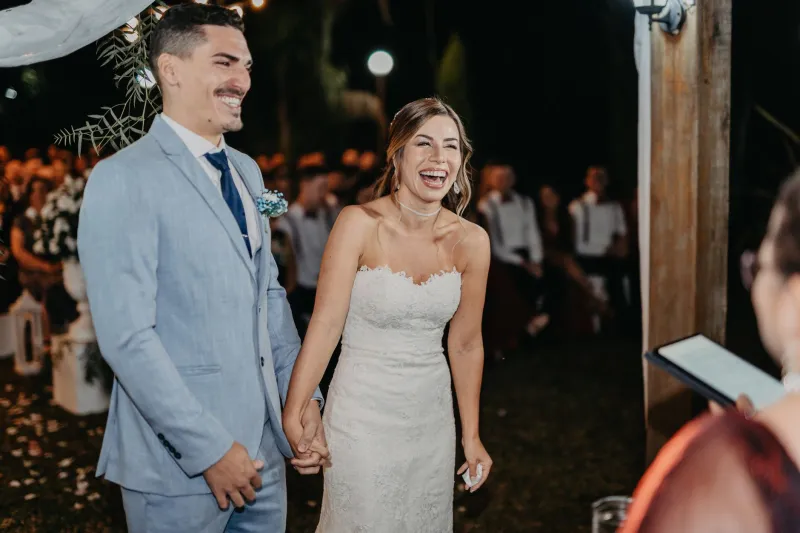
Ask any couple, six months after their wedding, which moment they return to most often. Rarely will they describe the processional in precise detail or recall the exact choreography of the first dance. More often, they'll speak of something smaller — a grandmother's hand squeezing theirs before the ceremony began, a childhood friend dissolving into laughter at the cocktail hour, a quiet two minutes alone on a balcony while the reception hummed below. These are the moments that resist scheduling. And yet, with thoughtful planning, they can be made far more likely to occur.
This is not an argument against structure. A well-designed wedding timeline is essential — it protects your vendors, respects your guests, and ensures the day unfolds with grace. But within that structure, there is an art to leaving room. The couples who feel most fully present on their wedding day are almost always the ones who understood, in advance, that the margins of the schedule are where the real story gets written.
Why Spontaneity Doesn't Happen by Accident
There is a certain irony in the idea of planning for the unplanned. And yet, anyone who has coordinated a large-scale event understands that spontaneity is, in fact, a byproduct of preparation. When every logistical detail has been accounted for — when vendors know their cues, when transportation is confirmed, when the timeline has been stress-tested — the couple and their guests are free to simply be present. Anxiety crowds out authenticity. The more uncertainty lingers in the background of a wedding day, the less emotional bandwidth anyone has for the quiet, unscripted connections that make a celebration feel alive.
In practical terms, this means that protecting spontaneous moments begins weeks before the wedding itself. It means working with your coordinator to build buffer time into the day rather than treating every minute as an opportunity to accomplish something. It means resisting the temptation to schedule every interaction and instead trusting that, when people who love you are gathered in one place, meaning will find its own way to the surface.
The Case for Buffer Time
One of the most common mistakes couples make when reviewing their wedding day timeline is treating buffer time as wasted time. In reality, it is the opposite. Those fifteen minutes between the end of portraits and the start of cocktail hour are not an inefficiency — they are an invitation. They are the window in which your new spouse might pull you aside to share something they couldn't say during the ceremony. They are the space in which your college roommate might find you and say the thing they've been meaning to say for years.
When building your timeline, consider identifying two or three intentional pauses — moments with no assigned purpose other than presence. These need not be long. Even ten unscheduled minutes, positioned thoughtfully within the arc of the day, can yield memories that outlast any carefully planned element of the reception. Discuss these pockets of time with your coordinator so that well-meaning family members and vendors understand they are protected, not available for repurposing.
Designing the Conditions for Connection
While you cannot script a genuine moment, you can absolutely design the conditions that make such moments more likely. The physical layout of your venue, the pacing of your cocktail hour, the way seating is arranged — all of these decisions either encourage or inhibit the kind of organic conversation and connection that gives a wedding its warmth.
Consider, for instance, the cocktail hour. When this transition is too brief or too rigidly programmed, it becomes a logistical corridor rather than a gathering. When it is given adequate time and a comfortable, unhurried atmosphere, it transforms into something closer to a reunion — a space where your guests rediscover one another, where old stories surface, where the emotional temperature of the room begins to rise in a way that carries beautifully into the reception.
Similarly, the placement of lounge seating, the presence of a quiet corner away from the band, or even the decision to step outside briefly during the reception can all create the conditions for a conversation or a moment that neither you nor your guests anticipated. These are not accidents. They are the result of thoughtful design.
Letting Go of the Highlight Reel Mentality
Modern wedding culture has an understandable tendency to frame the day as a series of photogenic peaks — the first look, the first kiss, the first dance. These moments matter, and they deserve care and attention. But an exclusive focus on the mountaintops can cause couples to miss the terrain between them, which is often where the most human and tender experiences unfold.
A bride pausing in a stairwell to collect herself before the processional. A father sitting quietly at a table during the reception, watching his daughter dance. Two groomsmen sharing a joke that sends them both into barely-suppressed laughter during the ceremony. None of these moments appear on any timeline. All of them are irreplaceable.
Permit yourself to release the expectation that your wedding day must be a continuous sequence of perfect, camera-ready events. The day will be richer, and you will be more present within it, if you approach it instead as a series of human experiences — some of which will be beautiful precisely because no one planned them.
A Word on Presence
All of this — the buffer time, the thoughtful design, the willingness to release the highlight reel — ultimately serves a single purpose: keeping you present in your own wedding day. It is a more difficult task than it sounds. The day moves quickly, demands are constant, and the sheer weight of the occasion can make it difficult to inhabit any single moment fully.
One practical approach is to choose, in advance, two or three specific moments during which you will consciously set aside any logistical awareness and simply notice what is happening around you. Perhaps it is the five minutes immediately following your ceremony. Perhaps it is a slow song late in the reception, when the crowd has thinned and the evening has softened. Identify these moments with your partner beforehand, and treat them as quietly sacred.
The unscripted moments of your wedding day are not interruptions to what you have planned. They are the evidence that what you have planned worked — that you created a day spacious enough for real life to enter it. That is, in the end, the highest achievement of any wedding well made.