When the Script Goes Out the Window: Celebrating the Unrehearsed Moments That Define Your Wedding Day
Every couple who has ever planned a wedding knows the particular comfort of a well-organized timeline. There is genuine peace in knowing that the florist arrives at nine, the first look is scheduled for two, and dinner rolls out precisely at six-thirty. Careful planning is not merely a luxury—it is the foundation upon which a beautiful day is built.
And yet, ask almost any couple what they remember most vividly from their wedding day, and the answers rarely align with what appeared on the schedule.
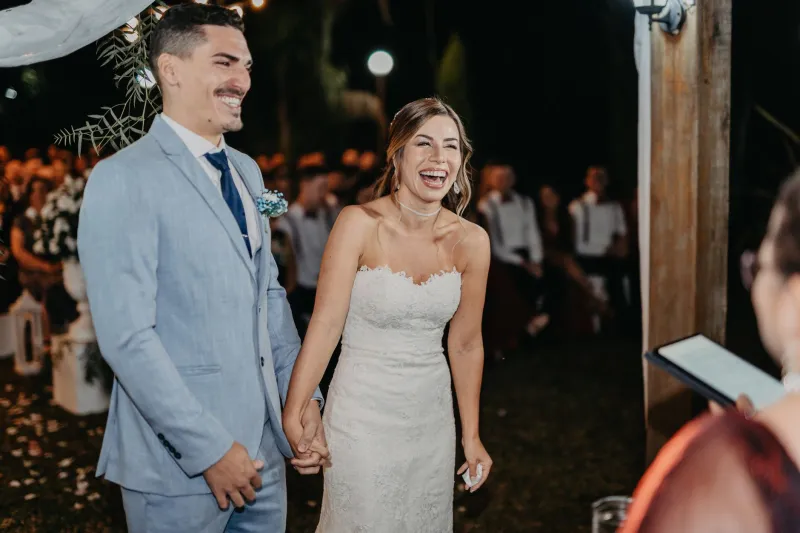
They remember the flower girl who abandoned her basket halfway down the aisle and simply sat down in the grass. They remember the officiant who, after years of performing ceremonies, paused mid-script and said something so unexpectedly true that the entire room held its breath. They remember the uncle who had never once danced at a family event suddenly pulling everyone onto the floor at ten o'clock, transforming the reception into something electric and entirely its own.
These moments are not accidents. They are, in a very real sense, the wedding.
The Paradox of Perfect Planning
There is a tension at the heart of wedding coordination that experienced planners understand well: the more rigidly a day is structured, the less room it has to breathe. A timeline that accounts for every minute creates efficiency, but it can also create a kind of emotional compression—a subtle pressure on guests and vendors alike to stay within prescribed boundaries rather than respond to what the moment is actually calling for.
This does not mean that planning is the enemy of spontaneity. Quite the opposite. The most memorable unscripted moments tend to occur within celebrations that are exceptionally well-organized, precisely because the logistics are running smoothly enough that everyone—couple, guests, vendors—can relax into genuine presence.
The goal, then, is not to plan less. It is to plan in a way that leaves deliberate space for the unexpected.
Building Flexibility Into Your Wedding Architecture
Think of your wedding timeline less as a rigid sequence of events and more as a framework with intentional margins. A fifteen-minute buffer between your cocktail hour and dinner call might seem like wasted time on paper. In practice, it is the window in which your best friend from college finally gets the chance to tell you something she has been saving all day, or in which your grandmother and your new mother-in-law find themselves in a corner laughing about something no one else will ever fully know.
When working with your planner and vendors, communicate openly about which portions of the day can absorb a little flexibility. The ceremony processional and dinner service may need to run close to schedule, but the transition between cocktail hour and reception, or the space between the last formal dance and the open dancing, are natural moments to allow the evening to find its own rhythm.
It is also worth discussing with your photographer and videographer in advance. The professionals who capture truly extraordinary wedding imagery are those who know when to follow the shot list and when to set it aside entirely and simply watch what is unfolding in front of them. A candid that no one planned for often becomes the image a couple returns to again and again, decades later.
The Vendor Who Surprises You
Seasoned wedding professionals carry years of accumulated wisdom, warmth, and human connection into every event they serve. Occasionally—and beautifully—that experience surfaces in ways that transcend the professional relationship.
A bandleader who reads the room and pivots the setlist entirely. A catering captain who quietly orchestrates a second piece of cake for the couple without being asked. A florist who, upon learning the significance of a particular bloom, rearranges a centerpiece in the final hour to honor a memory.
These gestures are not in any contract. They emerge from genuine care, and they leave an impression that no planned detail could replicate. Fostering that kind of relationship with your vendor team—treating them as creative collaborators rather than service providers executing a checklist—creates the conditions in which such moments become possible.
Trusting Your Guests
One of the quieter anxieties of wedding planning is the fear that guests, left without direction, will drift or disengage. In reality, the opposite is often true. When guests feel genuinely welcomed rather than managed, they tend to rise to the occasion in remarkable ways.
The impromptu speech that moves the room to tears. The circle of children who organize their own dance party in the corner of the reception hall. The table of old friends who haven't seen each other in years and who, by the end of the evening, have renewed something important between them.
Your wedding is not a performance your guests are watching. It is an experience they are living alongside you. When the day is designed with that understanding, the boundaries between planned and unplanned begin to dissolve in the best possible way.
Letting Go Without Losing Control
Embracing the unexpected is not the same as surrendering control of your day. A skilled wedding coordinator holds the structure so that the couple never has to—which means that when something unscripted and wonderful begins to unfold, the couple is free to be fully present within it rather than glancing at a timeline.
This is, in many ways, the highest expression of professional coordination: not the flawless execution of a predetermined script, but the confident, graceful management of a living event—one that has its own intelligence, its own momentum, and its own capacity to surprise everyone in the room, including the people who planned it.
The stories couples tell about their weddings years later are almost never about the centerpieces or the menu cards. They are about the moments that couldn't have been anticipated, the ones that arrived unbidden and stayed forever.
Leave room for those moments. They are, in the end, what your wedding is actually made of.