Beyond the Beautiful: Designing a Wedding That Speaks to Every Sense in the Room
There is a particular kind of wedding that stays with guests for years — not because the floral arrangements were extraordinary or the venue was spectacular, though both may have been true. It lingers because something about the day felt complete. The air carried a fragrance that seemed to belong there. The music swelled at precisely the right moment. The food told a story. The fabric of the chair sash was softer than expected. These details, often invisible in photographs, are the ones that live longest in memory.
At Matt Edge Weddings, we believe that genuine elegance is not a visual achievement alone. It is a fully realized experience — one that honors every sense your guests bring into the room. The following guide offers couples a framework for thinking beyond the aesthetic and into the sensory, so that your wedding day becomes something not merely seen, but deeply felt.
Sound: The Invisible Architecture of Emotion
Of all the senses, hearing may be the most powerful conductor of emotion. Research consistently shows that music activates memory and feeling more reliably than almost any other stimulus. This makes your wedding's sonic landscape one of the most consequential design decisions you will make — and one of the most frequently underestimated.
Begin by considering the emotional arc of your day. The ceremony calls for a different quality of sound than the cocktail hour, which differs again from the reception's opening moments. A string quartet playing Bach during the processional creates an atmosphere of reverence and weight. That same ensemble transitioning to a jazz standard during cocktails signals a welcome shift in energy. A live band launching into a Motown classic as the couple enters the reception transforms a room instantaneously.
Do not overlook the quieter intervals. The silence before the officiant begins, or the hush that falls during vows, carries its own profound power. Discuss with your musicians or DJ how to honor those pauses rather than fill them reflexively. The spaces between the notes matter as much as the notes themselves.
Consider also ambient sound — the subtle hum of a fountain in a garden ceremony, or the deliberate absence of background music during dinner so that conversation becomes the soundtrack. These choices communicate intentionality to your guests, even if they cannot articulate why the atmosphere feels so considered.
Scent: The Sense That Bypasses Logic Entirely
Scent is processed by the brain's limbic system, the same region that governs emotion and long-term memory. This means that a fragrance experienced at your wedding may, years later, transport a guest back to that exact moment with startling clarity. Used thoughtfully, scent becomes one of your most powerful tools for creating lasting impression.
A cohesive fragrance narrative begins with your florals. Work with your florist to select blooms that carry natural scent — garden roses, gardenias, jasmine, sweet peas, and lily of the valley are among the most evocative — and consider how those scents will interact with the space. A heavily perfumed arrangement in a small indoor ceremony can overwhelm; the same flowers in an open garden setting feel lush and romantic.
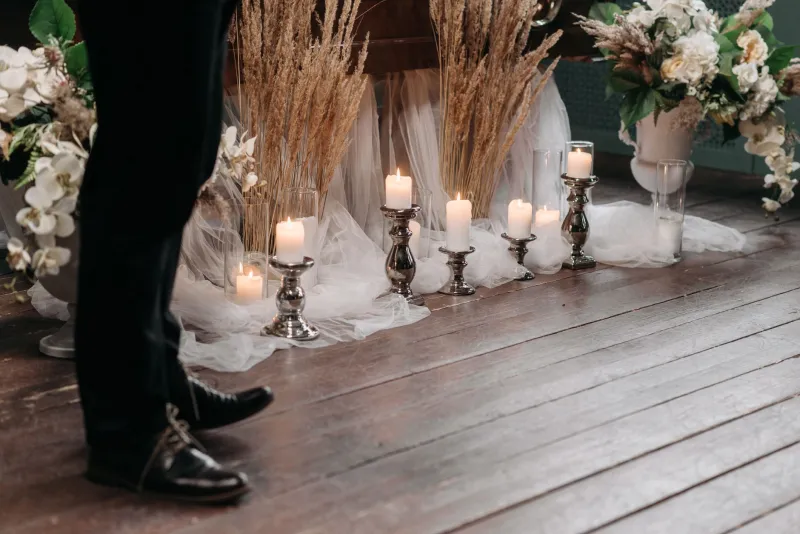
Beyond flowers, consider candles and diffusers in reception spaces, particularly for evening celebrations. A warm, woody fragrance with notes of cedar or sandalwood creates an entirely different atmosphere than something bright and citrus-forward. Choose a signature scent and use it consistently across the venue — it becomes, in effect, the olfactory identity of your wedding day.
One often-overlooked opportunity: scented elements in your stationery suite. Subtle fragrance applied to envelopes or programs creates a sensory impression before guests even arrive, setting an expectation of care and attention to detail.
Taste: Building a Flavor Narrative Through Food and Drink
A wedding menu is far more than sustenance. At its best, it is a form of storytelling — one that reflects the couple's history, regional identity, and shared values. Couples who approach their food and beverage program with the same intentionality they bring to their floral design find that the result is something guests discuss long after the event concludes.
Begin with a signature cocktail that carries meaning. Perhaps it incorporates a spirit from the region where you met, or a flavor profile that nods to a favorite travel destination. Even something as simple as a lavender lemonade or a spiced bourbon punch becomes memorable when paired with a handwritten card explaining its significance.
For the menu itself, consider a throughline — a flavor, an ingredient, or a culinary tradition that appears across multiple courses in different forms. A couple with Southern roots might weave in elements of Low Country cuisine from the passed hors d'oeuvres through the dessert course. A couple who met in New Orleans might feature beignets alongside the wedding cake. These threads of continuity create a dining experience that feels authored rather than assembled.
Do not neglect texture as a component of taste. The contrast between a crispy crostini and a silky mousse, or between a tender braised protein and a bright, crunchy slaw, keeps the palate engaged and elevates even familiar flavors into something more dynamic.
Touch: Inviting Interaction Through Texture and Material
The tactile dimension of a wedding is perhaps the most subtle, yet it shapes the overall impression of your event in ways guests absorb unconsciously. The weight of a linen napkin, the smoothness of a marble table number, the softness of a velvet ribbon on a bouquet — these details register as quality without requiring any conscious evaluation.
Fabric choices across your wedding — bridal attire, bridesmaids' gowns, linens, drapery, and chair treatments — contribute to a collective textural vocabulary. A wedding that pairs silk charmeuse with raw-edged linen and aged brass hardware communicates something entirely different from one that combines sequined overlays with acrylic chairs and mirrored surfaces. Neither is inherently superior, but coherence within the chosen language matters enormously.
Floral design also offers rich tactile opportunity. Encourage your florist to incorporate blooms and greenery with varied textures — the soft velvet of a garden rose petal, the architectural stiffness of a protea, the delicate lace of Queen Anne's lace. When guests reach out to touch an arrangement, as they inevitably will, that interaction becomes a small, private moment of connection with your wedding's design.
Finally, consider your paper goods. A thick, cotton-rag invitation suite with letterpress printing invites guests to run their fingers across the impression. A ceremony program printed on translucent vellum has an entirely different character. These choices are felt, quite literally, before they are read.
Weaving It All Together
The most elegant multi-sensory weddings are not those that maximize each sense independently, but those that allow every element to speak a common language. When the warm amber candlelight complements a fragrance of amber and vanilla, which in turn harmonizes with the caramelized notes in the dessert course, while a jazz trio plays softly beneath the murmur of conversation — that is coherence. That is a wedding that has been designed, not merely decorated.
At Matt Edge Weddings, the work of creating these layered experiences is one we approach with both rigor and genuine joy. Every couple brings a unique story, and every story deserves a sensory environment worthy of it. The goal is always the same: to craft a day so fully realized that your guests carry it with them not just as a memory, but as a feeling they can almost reach out and touch.