The Spaces Between: Designing Your Wedding's Transition Moments With the Same Care as Everything Else
Ask any experienced wedding planner which moments on a timeline they watch most carefully, and the answer may surprise you. It is not the ceremony. It is not the first dance or the cake cutting or the grand exit. It is the fifteen minutes after the ceremony ends. The gap between cocktail hour and dinner. The pause before the dance floor opens.
These are the transition moments—the connective tissue of a wedding day—and they are among the most consequential and least discussed elements of celebration design. When they are handled thoughtfully, guests barely notice them; the day simply flows. When they are neglected, something harder to name begins to happen: the energy of the room dips, guests drift toward their phones, conversations lose their momentum, and the emotional current that was building so beautifully starts to dissipate.
At Matt Edge Weddings, we treat transitions not as logistical gaps to be managed, but as intentional experiences to be designed. Here is what that looks like in practice.
Understanding What Transitions Actually Do
Before we talk about design, it is worth understanding the psychological function that transitions serve in a celebratory context. A wedding is not a single sustained emotional experience—it is a series of distinct movements, each with its own register, its own energy, its own demands on the people present.
The ceremony asks for stillness, attention, and emotional openness. The cocktail hour invites ease, movement, and social reconnection. The reception dinner balances intimacy and spectacle. The dance floor calls for release and abandon. Moving between these states requires time and permission. Guests cannot simply be commanded from one emotional mode to another by a DJ announcement.
Transitions, when designed well, serve as decompression chambers—spaces where guests can exhale, reorient, and prepare to receive what comes next. Designed poorly, they become dead zones: undefined moments where no one knows quite what they should be doing, and the gathering loses its collective sense of purpose.
The Post-Ceremony Window
The fifteen to twenty minutes immediately following the ceremony are perhaps the most emotionally charged transition of the entire day. Guests have just witnessed something profound. They are full of feeling—moved, perhaps tearful, certainly ready to express something. What they need in this moment is permission and invitation.
If guests exit a ceremony to find themselves in a narrow hallway with no clear direction, no music, and no refreshments while they wait for the couple to finish photographs, that emotional fullness begins to deflate. The moment passes. By the time they reach the cocktail area, the feeling has become something more like mild impatience.
Contrast this with an exit that leads directly into a warmly lit outdoor space where a string quartet is already playing, a signature cocktail is being passed, and the couple's closest friends are gathering naturally—and you have a transition that extends and amplifies the ceremony's emotional power rather than interrupting it.
The physical path your guests travel in those first minutes after your vows matters. Walk it yourself during your venue visit. Ask where the light is, where the sound will carry, where people will naturally gather. Then design into that space rather than against it.
Cocktail Hour as Intentional Experience
Cocktail hour has a reputation as a holding pattern—a polite way of keeping guests occupied while the couple completes portraits. This framing does cocktail hour a disservice, and it often becomes a self-fulfilling prophecy.
Cocktail hour is, in fact, one of the best opportunities in the entire day for genuine human connection. It is the moment when guests from different parts of your life—college friends, work colleagues, family members who have never met—are most naturally inclined to introduce themselves and find common ground. The couple may not be present, but the celebration is fully underway.
To make cocktail hour feel like an event rather than an interlude, consider the following: Is there a focal point that draws people into the space? Is the music at a volume that encourages conversation rather than competing with it? Are there interactive elements—a photo display of the couple's history, a guest book with a specific prompt, a food station that invites lingering—that give guests something to do with their hands and their attention?
Cocktail hour energy, when properly activated, carries directly into the reception room. Guests who arrive at dinner already warm, already connected, already slightly elevated by good food and good company will fill a reception room with a very different energy than guests who have been standing around for forty-five minutes wondering when things will begin.
The Ceremony-to-Reception Room Move
The moment when guests are asked to move from cocktail hour into the reception room is a transition that many couples underestimate. Handled abruptly—a DJ announcement, a mass migration, the jarring shift from one acoustic environment to another—it can deflate the room's energy just as the evening is building.
Handled with intention, it becomes a moment of genuine anticipation. Consider how the room reveal can function as an experience in itself: doors opened simultaneously, a brief musical cue that signals arrival rather than instruction, lighting that shifts as guests enter. These are small choreographic choices, but they communicate to guests that they are moving into a new chapter of the evening—one worth being present for.
Activating the Dance Floor Without Forcing It
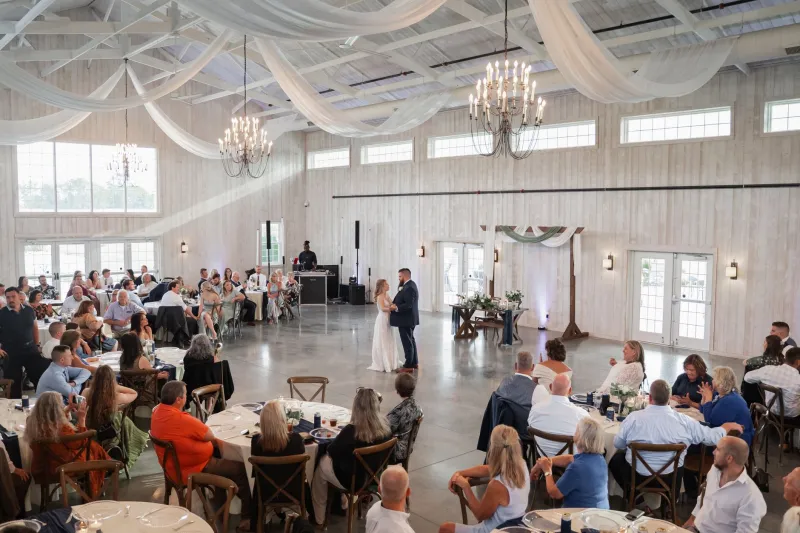
One of the most common energy failures in wedding receptions occurs in the transition between dinner and dancing. The couple has their first dance. Perhaps the parents join for their dances. Then the DJ invites everyone to the floor—and almost no one moves.
This is not a music problem. It is a transition problem. Guests have been seated for ninety minutes or more. They have eaten. They are warm and settled. The physical and psychological distance between their chairs and the dance floor, in that moment, is significant.
The most effective dance floor activations begin before the first song is called. They involve the couple moving through the room in the final minutes of dinner—stopping at tables, pulling friends to their feet, building a small critical mass that reaches the floor together. They involve a song selection for the first open dance that is familiar enough to feel like an invitation rather than a performance. They involve a room temperature and lighting shift that signals to the body as much as the mind that the energy of the evening is changing.
The Quiet Art of Invisible Design
The goal of transition design is, ultimately, invisibility. When these moments are executed well, no guest will remark upon them. They will simply say, at the end of the evening, that the wedding felt effortless—that it moved beautifully, that they were never quite sure how the hours passed so quickly.
That feeling of effortlessness is not luck. It is craft. It is the result of someone having asked, long before the wedding day, what would happen in the spaces between—and having answered that question with the same care and intention brought to every other element of the celebration.